

Key Takeaways
- Public universities must respect First Amendment rights, but can impose narrow restrictions on true threats, harassment, incitement, and unlawful conduct
- Speech protections vary between public campus areas (broader protections) and classrooms or private spaces (more restricted)
- Time, place, and manner restrictions are permitted if content-neutral, narrowly tailored, and if they provide alternative channels for expression
- University employees have different speech protections depending on whether they speak as citizens or in their official capacity
- Within reason, universities can establish free speech zones and regulate demonstrations to prevent substantial disruption
Understanding the limits of freedom of speech on public university campuses requires navigating a complex intersection of constitutional law, educational policy, and practical campus management. Public universities, as government entities, must respect the First Amendment and must also maintain an educational environment conducive to learning and safety.
The First Amendment guarantees freedom of speech, but public universities can regulate specific categories of speech. Universities can implement reasonable, content-neutral restrictions based on time, place, and manner. These limitations vary significantly depending where on campus the speech occurs and in what context the speaker is speaking.
Core Categories of Unprotected Speech on Campus
Public universities can restrict several narrow categories of speech. These categories fall outside First Amendment protections. These exceptions exist because compelling government interests override free speech considerations.
True Threats: In Virginia v. Black, 538 U.S. 343, 359 (2003), the Supreme Court held that true threats are serious expressions of intent to commit unlawful violence to a specific individual or group of individuals. A true threat must convey genuine intent to cause bodily harm rather than mere hyperbole or political rhetoric. Universities can limit speech that constitutes a true threat without violating the First Amendment.
Incitement: In Brandenburg v. Ohio, 395 U.S. 444 (1969), the Supreme Court held that speech promoting imminent lawless action can be restricted only when it’s intended and likely to produce such action. Mere advocacy of violence receives First Amendment protection unless it creates a present danger of immediate lawless conduct. Campus speakers cannot face discipline for discussing controversial topics or expressing unpopular viewpoints unless their speech is directed towards inciting imminent violence.
Harassment: Harassment is unwelcome, discriminatory speech based on protected characteristics that is so severe, pervasive, and objectively offensive that it denies its victims access to educational benefits or opportunities. The Supreme Court established that isolated offensive comments are usually protected speech, but systematic targeting that creates hostile environments may justify intervention. Universities must balance free speech protections with their obligation to provide equal educational opportunities under federal law.
Speech Integral to Criminal Conduct: While political speech and symbolic speech are protected, the First Amendment does not protect speech that is used as an integral part of conduct that violates applicable state law (such as extortion).
Public Campus Areas vs. Classrooms and Private Spaces
To determine when a public university may lawfully regulate speech, one must consider where on campus the speech occurred.
Public Campus Areas
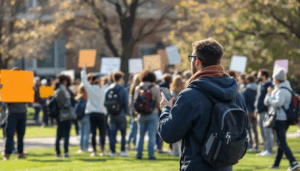
Designated public forums include places like sidewalks, quads, and common outdoor spaces. The First Amendment protects the broadest range of speech in these areas, and any limits on speech must be viewpoint and content neutral; narrowly tailored to serve an important government purpose; and leave ample opportunity for alternative channels for expressive activity.
When a public university creates a “free speech zone” by limiting protests or demonstrations to specific areas of campus, the policy must be carefully evaluated to ensure that it complies with the First Amendment.
Classrooms and Academic Spaces
Classrooms operate under different constitutional principles that allow content-based restrictions for legitimate educational purposes. Faculty possess academic freedom to present material relevant to their scholarly subjects using appropriate pedagogical methods, while universities maintain authority over curriculum content and classroom management.
Student speech in classroom discussions receives protection when contributing to educational discourse, but institutions can restrict expression that disrupts the learning environment or targets individual students inappropriately. The Supreme Court case Hazelwood School District v. Kuhlmeier, 484 U.S. 260 (1988) provides a framework for the regulation of speech in educational settings, though university students generally receive stronger protections than K-12 pupils.
Private Spaces and Dormitories
Dormitories, private offices, and administrative buildings allow universities greater regulatory authority. In these non-public fora, universities may enact reasonable restrictions based on residential community standards, workplace policies, and operational needs. Universities can implement noise ordinances, establish quiet hours, and regulate posting of materials while upholding students’ First Amendment right to engage in private conversations and personal expression.

Academic Freedom in Classroom Settings
Academic freedom provides additional First Amendment protections specific to the educational environment. Faculty members can present controversial material, assign challenging readings, and facilitate difficult discussions as part of their professional responsibilities.
Faculty Rights include freedom to pursue research, publish findings, and present course content relevant to their academic disciplines. The First Amendment protects professors from discipline based solely on expressing unpopular academic viewpoints or assigning controversial materials with legitimate pedagogical purposes. However, academic freedom doesn’t protect harassment of students, persistent disruption of educational objectives, or speech unrelated to scholarly activities.
Student Rights in classroom settings include participating in discussions, asking questions, and expressing dissenting viewpoints respectfully. Universities cannot punish students for political opinions or controversial perspectives expressed during appropriate academic discourse. However, institutions may regulate disruptive outbursts, personal attacks on classmates, or speech that prevents normal class proceedings.
Curriculum Authority allows universities to establish educational standards, approve course content, and maintain academic integrity. Faculty cannot claim unlimited freedom to ignore approved curricula or institutional educational objectives under the guise of academic freedom.
Time, Place, and Manner Restrictions
Universities can implement content-neutral regulations that serve substantial government interests while providing ample alternative channels for communication. These restrictions must be narrowly tailored to address specific institutional needs without targeting particular viewpoints.
Permissible Restrictions include things like noise ordinances during final exams, permit requirements for large gatherings that could impact campus operations, and designated areas for amplified speech. Universities may restrict posting of materials to specific bulletin boards, limit demonstration duration to prevent indefinite occupation of public spaces, and establish reasonable hours for outdoor activities near dormitories.
Prohibited Restrictions include regulations that favor certain political viewpoints, discriminate against unpopular speakers, or create arbitrary barriers to expression. Universities cannot ban demonstrations simply because they oppose institutional policies or create controversy within the campus community.
The Supreme Court ruled in Ward v. Rock Against Racism, 491 U.S. 781 (1989) that while a New York City ordinance did regulate speech, it was a legitimate time, place, and manner restriction. The ordinance was content neutral, served the government’s legitimate interest in controlling noise, and it left open other channels for expression.

Employees’ Speech Rights
University employees navigate complex speech protections that depend on whether they speak as private citizens on matters of public concern, or in their professional capacity.
The Pickering test from Pickering v. Board of Education, 391 U.S. 563, (1968) balances employees’ speech rights with employers’ operational needs. Public employees retain First Amendment rights when speaking as citizens on matters of public concern, but employers may discipline speech that disrupts the workplace, undermines institutional missions, or relates to employees’ official duties.
Universities cannot retaliate against faculty or staff for expressing political opinions, criticizing government policies, or participating in public debates as private citizens.
Workplace speech receives limited constitutional protection. Under Garcetti v. Ceballos, 547 U.S. 410, (2006), the Supreme Court held that public employees do not have First Amendment protection for speech made as part of their official job duties. A number of federal appellate courts, however, have ruled that this calculus is different when public-university faculty are speaking on matters related to teaching and scholarship. This is because of the special role that free speech plays in the university setting.
Public concern analysis requires courts to determine if employee speech addresses issues of legitimate public interest rather than personal grievances or internal workplace disputes. Speech about broad political or social issues that affect the community typically qualify as issues of public concern.
Student Employee Considerations
Graduate teaching assistants, research assistants, and other student employees possess dual status that creates unique speech considerations. These individuals retain their rights as students in most campus contexts, while accepting limited employment obligations in their official capacities.
Universities may establish policies governing official communications, classroom conduct, and representation of institutional positions during employment duties. However, student employees maintain full speech protections in their personal capacity and in areas unrelated to their work responsibilities.

Enforcement and Reporting Mechanisms
Universities must establish fair procedures for investigating alleged speech violations while respecting constitutional protections.
Reporting procedures typically allow community members to report true threats, harassment, or disruptive conduct through designated campus offices. Institutions should provide clear guidance on what constitutes reportable behavior (i.e., what is unprotected speech) to avoid creating a “chilling effect” on protected speech.
Due process requires that public universities provide adequate notice of charges and an opportunity to respond before imposing serious discipline for speech-related violations.
Graduated sanctions range from educational interventions and warnings for minor infractions to suspension or expulsion for serious violations. Penalties should be proportionate to the violation and the university should consider whether there are less restrictive alternatives.
Appeal processes provide additional safeguards against erroneous discipline for protected expression. Students and employees should have access to independent review bodies that can evaluate whether university speech restrictions comply with the First Amendment.
Frequently Asked Questions
Can a public university create speech codes prohibiting offensive language? No, public universities cannot ban speech simply because it is offensive, racist, or hateful unless it falls into narrow unprotected categories like true threats or harassment that denies equal educational access. Federal courts have struck down numerous campus speech codes that attempted to regulate hate speech or offensive expression. While such language may be morally objectionable, the First Amendment protects even deeply offensive political speech from government censorship.
Do students have the same free speech rights in dormitories as in public campus areas? No, dormitories are considered private spaces where universities can impose reasonable regulations for things like community living and safety. While students retain core free speech protections in residential areas, institutions may establish quiet hours, regulate guest policies, and address conduct that substantially disrupts residential communities. However, universities cannot restrict private conversations, personal expression, or political viewpoints simply because they occur in residential settings.
Can professors be disciplined for controversial statements made on social media? It depends on whether they were speaking as private citizens on matters of public concern or in their official capacity. Faculty members generally retain strong protection for personal political expression on social media, but may face discipline for statements that clearly identify them as institutional representatives or directly relate to their employment duties.
Are there different rules for guest speakers invited by student organizations? Public universities generally cannot exclude speakers based on their viewpoint, but can impose reasonable security requirements in addition to time, place, and manner restrictions. Institutions must provide equal access to campus facilities regardless of speaker ideology and cannot charge student organizations extra security fees because the speaker they have invited is controversial or unpopular.
What constitutes “substantial disruption” that allows universities to restrict speech? Courts look at whether speech materially interferes with educational activities, creates safety concerns, or prevents normal university operations. Substantial disruption typically involves preventing classes from meeting, blocking access to campus buildings, creating genuine safety hazards, or engaging in conduct that makes normal educational activities impossible. The standard requires actual interference with institutional functions rather than speculative concerns about potential problems or community discomfort with controversial messages.