
Is hate speech illegal in the U.S.? In most cases, it is protected under the First Amendment. The U.S. Supreme Court has repeatedly ruled that most speech considered ‘hate speech’ is legally protected under the First Amendment. Many Americans support robust free speech protections, even for hate speech, reflecting a broad public consensus on the importance of First Amendment rights. However, there are exceptions for speech that incites violence or constitutes a true threat. This article examines these legal boundaries, Supreme Court rulings, and the differences between hate speech and hate crimes.
Key Takeaways
- The First Amendment generally protects hate speech in the U.S., reflecting a commitment to free expression, even when such speech is offensive.
- Key Supreme Court rulings, like Brandenburg v. Ohio and Chaplinsky v. New Hampshire, define the limits of protected speech, emphasizing exceptions for incitement, fighting words, and true threats.
- Hate speech is distinct from hate crimes; while the former is not criminalized, the latter involves unlawful actions motivated by bias and carries legal consequences.
Constitutional Protections for Free Speech
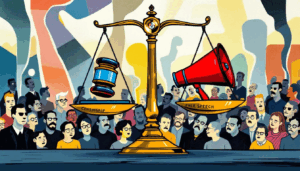
The First Amendment to the United States Constitution is a cornerstone of American democracy, providing robust protections for various forms of expression that are at the heart of a free society. It safeguards not only the freedom of speech but also the freedoms of religion, free press, peaceful assembly, and petitioning the government. The First Amendment ensures that individuals can express their ideas and opinions without fear of government intervention, fostering a vibrant and open public discourse.
One of the most debated aspects of the First Amendment is its application to hate speech. Despite being offensive or hurtful, hate speech is generally protected under the First Amendment based on the principle of individual freedom of speech. The First Amendment protects a wide range of speech—even deeply offensive speech—but there are specific exceptions such as incitement to violence, true threats, and harassment. However, there is no specific exception within the First Amendment that categorically excludes hate speech from its protections. This means that, in most cases, even speech that demeans or expresses hatred against specific groups is safeguarded by the constitutional guarantee of free speech.
Public universities in the United States are also bound by the First Amendment, ensuring that free speech rights are upheld on public university campuses. Most expression identified as hate speech is protected under the First Amendment and cannot be lawfully censored at public universities. These institutions must navigate the delicate balance between fostering a safe and inclusive learning environment and respecting the constitutional rights of students and faculty. Institutions must prohibit harassment, for example, but must also define harassment in a way that does not infringe on the First Amendment. Harassment, as defined by the Supreme Court in Davis v. Monroe County Board of Education, is conduct that is “so severe, pervasive, and objectively offensive” that it effectively denies the victim equal access to educational opportunities or benefits. This definition emphasizes the severity and pervasiveness of the conduct, as well as its impact on the victim’s ability to participate in or benefit from an educational program, and balances universities’ obligation to prevent harassment while also protecting free speech.
Supreme Court Rulings Relevant to Hate Speech
 The Supreme Court has played a pivotal role in shaping the legal landscape of free speech in the United States, particularly concerning hate speech. One landmark case is Brandenburg v. Ohio, in which the Court ruled that advocacy of illegal conduct is protected under the First Amendment unless it is directed to inciting imminent lawless action.
Another significant case is Chaplinsky v. New Hampshire, where the Supreme Court confirmed that speech can be lawfully restricted if it provokes immediate violence—the so-called “fighting words” doctrine. The Court recognized that such expressions are not protected by the First Amendment because they inflict injury or incite an immediate breach of peace. This ruling introduced the concept of fighting words into free speech jurisprudence, providing a framework for evaluating when speech crosses the line into unlawful territory.
The Supreme Court’s decision in Snyder v. Phelps reaffirmed the robust protections afforded to speech under the First Amendment, even when that speech is offensive or controversial. The case arose from a protest by the Westboro Baptist Church near the funeral of a Marine killed in action, where the group displayed inflammatory signs criticizing the United States and its policies. The Court held that the protestors’ speech was protected because it addressed matters of public concern, such as national policy and morality, and took place in a public forum. This ruling underscores the principle that the First Amendment safeguards speech on public issues, regardless of its emotional impact or the offense it may cause. By protecting even hateful or upsetting speech, the decision highlights the tension between free expression and societal discomfort, ultimately prioritizing the former as essential to democratic discourse.
The Supreme Court has also held that hate speech may be used as evidence in enhancing sentences for hate crimes. In Wisconsin v. Mitchell, the Court upheld a Wisconsin statute that allowed for enhanced penalties when a crime was motivated by bias, such as racial animus. The Court reasoned that the statute did not violate the First Amendment because it targeted conduct, not speech, and that the evidentiary use of speech to establish motive or intent was permissible under the Constitution.
These rulings demonstrate the Court’s efforts to balance the protection of free speech with the need to address expressions that pose a genuine threat to public order and safety.
Exceptions to Free Speech Protections
While the First Amendment provides broad protections for free speech, certain types of expression are not protected. These exceptions include:
- Incitement: speech that encourages imminent lawless action and is not shielded by the First Amendment.
- Fighting words
- True threats
- Obscenity
Courts determine whether speech constitutes incitement by examining whether it is (1) directed to inciting or producing imminent lawless action and (2) likely to incite or produce such action. This standard requires both intent and a likelihood of imminent harm.
Fighting words are defined as expressions that by their very utterance inflict injury and provoke immediate violence, including the potential for bodily harm. Fighting words are often directed at a specific individual and are likely to provoke an immediate response. The courts assess the totality of the circumstances to determine if words qualify as fighting words, considering the context and the potential for immediate harm.
True threats are statements that express a serious intent to commit unlawful violence against a particular individual or group. These threats are not protected by the First Amendment because they pose a real and imminent danger of violence to the targeted individuals.
In harassment and hostile environment cases, courts use a reasonable person standard to determine whether conduct is sufficiently severe, pervasive, and objectively offensive to create a hostile or abusive environment.
Obscenity is another category of unprotected speech, defined as expressions that appeal to prurient interests and lack serious literary, artistic, political, or scientific value. By delineating these exceptions, the law aims to balance the protection of free expression with the need to safeguard individuals and society from harmful and dangerous speech.
Defining Hate Speech
 When people use the term “hate speech,” they are generally referring to speech that insults or demeans specific groups based on characteristics such as race, religion, national origin, gender identity, sexual orientation, or sexual identity. These expressions can be offensive and can contribute to a hostile environment for the targeted groups. But hate speech does not have a specific legal meaning the way that harassment or incitement does. For this reason, the subject of hate speech is often debated in academic and legal circles, with ongoing discussions about which topics and groups should be protected.
Hate speech can be offensive or hurtful. However, it is typically protected under the First Amendment. This protection underscores the principle that even distasteful or harmful speech must be tolerated to preserve the broader freedom of expression. Creating a universally accepted definition of hate speech is complicated by the varying perspectives and sensitivities of individuals and communities.
While the First Amendment safeguards a wide range of speech, including hate speech, society must still grapple with the ethical and social implications of allowing such expressions to persist.
Hate Speech vs. Hate Crimes
Understanding the distinction between hate speech and hate crimes is crucial. In the United States, hate speech by itself is not classified as a crime. The Bureau of Justice Statistics defines hate crimes as “Criminal offenses motivated, in whole or in part, by an offender’s bias against a race, religion, disability, sexual orientation, ethnicity, gender, or gender identity.” A hate crime is a criminal offense that is specifically motivated by bias, and it is important to note that hate speech alone does not constitute a hate crime; rather, hate speech may be used as evidence to prove the motivation behind a hate crime.
Hate speech used as evidence can enhance sentences for crimes classified as hate crimes, demonstrating its potential impact in legal proceedings. This distinction highlights the legal and practical differences between offensive speech and criminal behavior motivated by hate.
Individuals who experience or witness hate crimes should report them to local or state police and follow up with the FBI to ensure a thorough investigation. Support for victims of hate crimes is available through resources like the VictimConnect Resource Center, which offers assistance in finding local support services.
Perceptions of what constitutes hate speech can evolve over time, influenced by social and political changes. As society progresses, the line between protected speech and unlawful conduct may shift, reflecting changing values and priorities.
Internet and Social Media Implications
The internet and social media platforms have transformed the way we communicate, offering unprecedented opportunities for free expression. The internet receives the same full protection under the First Amendment as print media. This means that online speech, including hate speech, is generally protected, complicating efforts to regulate harmful expressions on digital platforms.
Efforts to limit hate speech online raise concerns about potentially suppressing dissenting opinions and public discourse. The challenge lies in balancing the protection of free expression with the need to create a safe and respectful online environment for all users.
Both digital media and social platforms enhance the ability to share and access information, making it more difficult to address hate speech without infringing on free speech rights. As society continues to navigate these challenges, ongoing dialogue and collaboration among community members, policymakers, and tech companies will be essential.
Free Speech in Higher Education
 Institutions of higher education have a dual responsibility to uphold free speech rights while ensuring an environment in which everyone has equal access to the institution’s educational opportunities and benefits. Public universities are bound by the First Amendment and cannot censor content or punish individuals solely for offensive messages. Universities often adopt anti-harassment codes to address discriminatory speech, but these codes must align with First Amendment protections.
Universities should create learning opportunities that promote understanding and respect. Educational initiatives and positive messaging are recommended strategies for addressing hate speech without infringing on free expression. Academic freedom in higher education is crucial for encouraging inquiry, discourse, and learning, and universities must navigate these principles carefully.
University employees retain their free speech rights as citizens, further complicating the balance between maintaining a respectful campus environment and protecting individual freedoms. Free speech principles suggest that the best way to counter hate speech is through additional speech promoting tolerance. By promoting a culture of respect and open dialogue, universities can address hate speech effectively while upholding constitutional guarantees.
Summary
The landscape of hate speech and its regulation in the United States is complex and multifaceted. The First Amendment provides broad protections for free speech, including hate speech, while also recognizing specific exceptions for speech that poses a genuine threat to public order and safety. Supreme Court rulings have significantly shaped our understanding of these protections and limitations, highlighting the delicate balance between free expression and societal well-being.
Defining hate speech remains a challenge due to its subjective nature, and differentiating it from hate crimes is crucial for understanding the legal landscape. The rise of the internet and social media has further complicated efforts to regulate harmful speech, underscoring the need for ongoing dialogue and collaboration among various stakeholders.
Universities and communities play a vital role in addressing hate speech while upholding constitutional guarantees. By promoting positive dialogue and educational initiatives, society can work towards creating a more inclusive and respectful environment. Ultimately, maintaining this balance is essential for preserving the core values of free speech and democratic discourse.
Frequently Asked Questions
Is hate speech illegal in the United States?
Hate speech is generally protected under the First Amendment in the United States, unless it falls into unprotected categories such as incitement or true threats. Therefore, it is typically not illegal.
What are some exceptions to free speech protections?
Certain exceptions to free speech protections include incitement to imminent lawless action, fighting words, true threats, and obscenity, which are all unprotected under the First Amendment.
How do Supreme Court rulings impact hate speech laws?
Supreme Court rulings, particularly in cases like Brandenburg v. Ohio, Chaplinsky v. New Hampshire, and Snyder v. Phelps, establish critical legal standards that define the limits of hate speech regulation. These decisions underscore that while hate speech may be offensive, it is often protected under the First Amendment unless it incites imminent lawless action.
How can hate speech be addressed?
Rather than focusing on reporting hate speech, many experts recommend responding with positive dialogue, education, and community engagement to effectively counteract hateful expressions. Encouraging open conversations and promoting tolerance within communities can create a more inclusive environment while preserving free speech rights. Taking proactive steps to foster understanding and respect is often a more constructive approach than formal reporting.
What role do universities play in addressing hate speech?
Universities play a crucial role in balancing free speech rights with the creation of a safe, inclusive environment by promoting positive dialogue and educational initiatives to counteract hate speech. This approach helps foster understanding and respect within the academic community.