

Key Takeaways
- Student conduct hearings are formal university processes aimed at determining if students violated the code of conduct, usually decided using a “more likely than not” evidence standard that can favor the institution’s interests.
- While students typically have rights to present evidence and call witnesses, the process is frequently structured to protect the university, making it critical for accused students to prepare thoroughly and seek a knowledgeable advisor.
- Conduct hearings are primarily designed to uphold university policies and community standards, which may not always align with the best interests of the accused student.
- Participants typically include the accused student, the complaining student (or faculty member, in academic misconduct cases), witnesses, advisors, and hearing officers or student conduct committee members.
- Appeals are possible but often limited in scope; understanding procedural requirements and deadlines is crucial for preserving rights.
- Key factors for fairness in hearings include impartiality of the panel, a clear student conduct process, adequate notice, and the opportunity to present evidence.
Introduction to Student Conduct
Accusations of a student conduct violation can be one of the most challenging moments in your academic career. Before proceeding, you should review the general information provided by the university about the hearing process, as it explains the rules, expectations, and procedures involved. Unlike a courtroom, these student conduct hearings are university-run processes where the university’s primary goal is to enforce its policies and protect its reputation, not your reputation. While the process is presented as fair and educational, students often find it heavily weighted against them. The typical hearing body or student conduct officer has broad discretion to interpret rules and determine outcomes, which can significantly impact your academic standing and future opportunities.
It is essential to approach this process with caution and recognize that your rights, although formally acknowledged, may be limited in practice. No student should assume that the hearing will be impartial or that the university will act solely in your best interest. Instead, prepare as if you are navigating a complex and adversarial system. Having an experienced advocate, such as a lawyer or knowledgeable advisor, can be critical in ensuring your side is effectively represented and your rights protected.
Understanding the procedures, gathering evidence, and carefully crafting your responses are vital to avoiding unfair outcomes. The university community expects compliance with its codes of conduct, but these standards are enforced through a process that prioritizes institutional interests. Your ability to navigate this process wisely can make a significant difference in the consequences you face.
Student Conduct and Community Standards
Universities emphasize community standards as the foundation of campus life, but these standards are enforced through mechanisms that often prioritize institutional control over individual fairness. The student conduct process aims to address behaviors deemed harmful to the community, yet the definition of misconduct can be broad and subjective. While universities often describe their conduct process as educational, many accused students experience it as intrusive, punitive, and intimidating. The hearing officer or student conduct committee typically operates within a framework that favors the university’s interests, including protecting its reputation and minimizing the risk of liability.
Students should be aware that taking responsibility or cooperating does not guarantee leniency in sanctions. It is critical to understand the risks involved and to approach the process with informed caution.

What is a Conduct Hearing?
A conduct hearing is a formal university procedure to determine whether a student violated the code of conduct or other university regulations. These hearings specifically address allegations of prohibited conduct as defined by university regulations. Unlike criminal or civil court proceedings, these hearings are administrative and primarily serve the university’s interests in maintaining order and enforcing policies.
The standard of proof—more likely than not—is lower than in criminal courts, making it easier for the university to find students responsible. The hearing process is not designed to protect students in the same way a legal system protects defendants.
Though the process is often presented to students as educational, you should prepare for a setting where the university controls the procedures and where the outcomes may affect your educational and career trajectory. The hearing officer or student conduct committee may limit the scope of testimony or evidence and has discretion in interpreting policies.
Types of Conduct Hearings
Universities use various formats for conduct hearings depending on the alleged violations, each with different levels of formality and decision-making structures.
- The Single Investigator Model places investigation and ultimate decision in the hands of a single hearing officer who reviews the case, makes the decision, and may impose sanctions. This process tends to be quicker but can be less transparent and more arbitrary, with decisions heavily influenced by the hearing officer’s discretion.
- Committee hearings involve panels composed of faculty, staff, and sometimes students. While this may seem like a more balanced approach, committees often follow university agendas and may lack legal expertise, which can disadvantage accused students.
- Specialized hearings address specific areas such as housing violations. These hearings may have additional rules and staff familiar with particular policies, but they still operate within the university’s administrative framework.
It is crucial to understand that none of these hearings equate to a court trial, and procedural protections are limited.
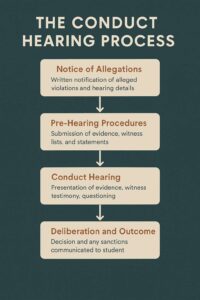
The Conduct Hearing Process
Initial Steps and Notification
The process begins with notification of alleged violations, typically delivered via official university email. Many times universities do not clearly specify the alleged violations in these notifications. They may simply quote the code of conduct rules that you are accused of violating but not include details. They may instead ask students to attend a meeting to discuss the accusations or ask questions without disclosing the specific charge. Written notices may also omit critical details necessary for effective preparation.
The timeline for response is often tight, requiring prompt action. Failure to respond or participate can lead to decisions being made without your input. Universities expect students to navigate these requirements independently, but seeking guidance is strongly advised. Extensions can usually be requested for time to find an advisor.
Pre-Hearing Procedures
The first step in the student conduct process is usually an interview with one or more investigators. Your advisor or legal counsel can help you prepare by conducting practice sessions.
Before a conduct hearing, students are usually given the opportunity to submit evidence and witness lists. All required documents and evidence must be submitted by the deadline. This can be challenging for students unfamiliar with the process. Preparation includes gathering evidence in advance and notifying witnesses.
Written statements and evidence must be carefully prepared, as late submissions may be disregarded. Witnesses with direct knowledge of the incident can be valuable, while character witnesses often carry little weight.
Understanding university policies is essential. These govern the hearing and sanctions. However, universities may interpret policies broadly to support disciplinary actions or their own interpretation of community values.
Preparing for Your Hearing

Preparation is critical to counterbalance the university’s institutional advantage. Students should:
- Seek experienced advisors or legal counsel who understand the conduct process and can help develop strategy.
- Collect and organize all relevant evidence, including communications, documentation, and witness statements.
- Take time to write clear, concise, and relevant statements addressing the allegations.
- Dress professionally and maintain respectful demeanor, as appearances and conduct can influence hearing officers’ perceptions.
- Understand that taking responsibility may have consequences but also may reduce your sanctions; weigh this decision carefully with an advisor. However, do not apologize for or admit to something you did not do.
Support for Accused Students
Navigating the process can feel overwhelming, but advisors—faculty, staff, or legal counsel—can provide guidance. They cannot usually speak during the hearing but can help prepare materials and strategy.
Students must submit all relevant evidence, including statements and documentation, before the hearing. Identifying credible witnesses is important. Reviewing the hearing packet in detail is essential, and students should request clarification if needed.
Support services, such as counseling, advocacy offices, or legal clinics, can provide emotional and practical help. Students should also request accommodations when necessary.
During the hearing, students typically present evidence, call witnesses, and make statements. They may also provide questions for the officer to ask of the complainant or witnesses. After deliberation, the body issues a decision and any sanctions. Appeals may be allowed in cases of procedural error, new evidence, or disproportionate sanctions.
Navigating the Conduct Process
The hearing involves respondents, complainants, witnesses, and advisors. The officer or committee manages the evidence and testimony.
Students should expect:
- To prepare an opening and closing statement.
- Limited opportunities to cross-examine witnesses, submit questions to the hearing body, or challenge evidence. Your right to present and challenge evidence will be limited compared to court settings.
- The hearing proceeds even if the accused student chooses not to attend, potentially leading to decisions without their input.
- The process is generally conducted in closed session, limiting transparency.
- The hearing officer or committee focuses on institutional policies and may prioritize “community standards” over individual circumstances.
Sanctions and Educational Interventions
Sanctions range from warnings to suspension or expulsion. They are described as educational but carry serious consequences. Interventions may include workshops, service, or reflection assignments, enforced with deadlines and penalties. Universities may impose severe sanctions even for first offenses.
Appeals Process
Appeals offer limited review, typically for procedural errors, new evidence, or disproportionate sanctions. Deadlines are strict. Advisors or legal counsel should be consulted before filing an appeal.
FAQ
Can I have a lawyer represent me in a conduct hearing?
Most institutions allow a lawyer as an advisor but not as a spokesperson. Legal counsel is strongly recommended for preparation.
What happens if I don’t show up?
The hearing will proceed without you, and decisions will be made based on the evidence presented.
How is the evidence standard different from a criminal court?
The more likely than not standard requires only that it is more probable than not that a violation occurred. This is lower than beyond a reasonable doubt in criminal courts.
Can I request a postponement of my hearing?
Postponements are discretionary but usually granted for valid reasons, such as securing an advisor. Requests should be prompt, reasonable, and documented.
What if I disagree with the disciplinary decision?
You may appeal, but appeals usually focus on procedural issues or new evidence. It is generally easier to achieve a favorable outcome at the initial hearing.
Final Considerations
University conduct hearings are complex processes that often favor institutional interests over individual fairness. Students must approach them with caution, thorough preparation, and strong support.
Understanding the process, knowing your rights, and securing experienced advocacy can significantly improve your ability to navigate proceedings and protect your academic future. The outcome may have lasting consequences, so treat the process seriously and seek help to ensure your voice is effectively heard.